WORKPLACE PROGRAM · THE RELATIONAL WORKER TOOLKIT
Essential learning for demanding, relational work.
Practical, trauma-informed learning for people working across care, health, education, community services and other fields where relationships are central to the work.
The Relational Worker Toolkit develops the skills and understanding that help people navigate emotional labour, recognise the effects of demanding work, practise recovery and learn through reflection. It brings together psychological and systems perspectives, embodied practices and practical tools that can be applied in everyday work.
THREE AREAS OF LEARNING
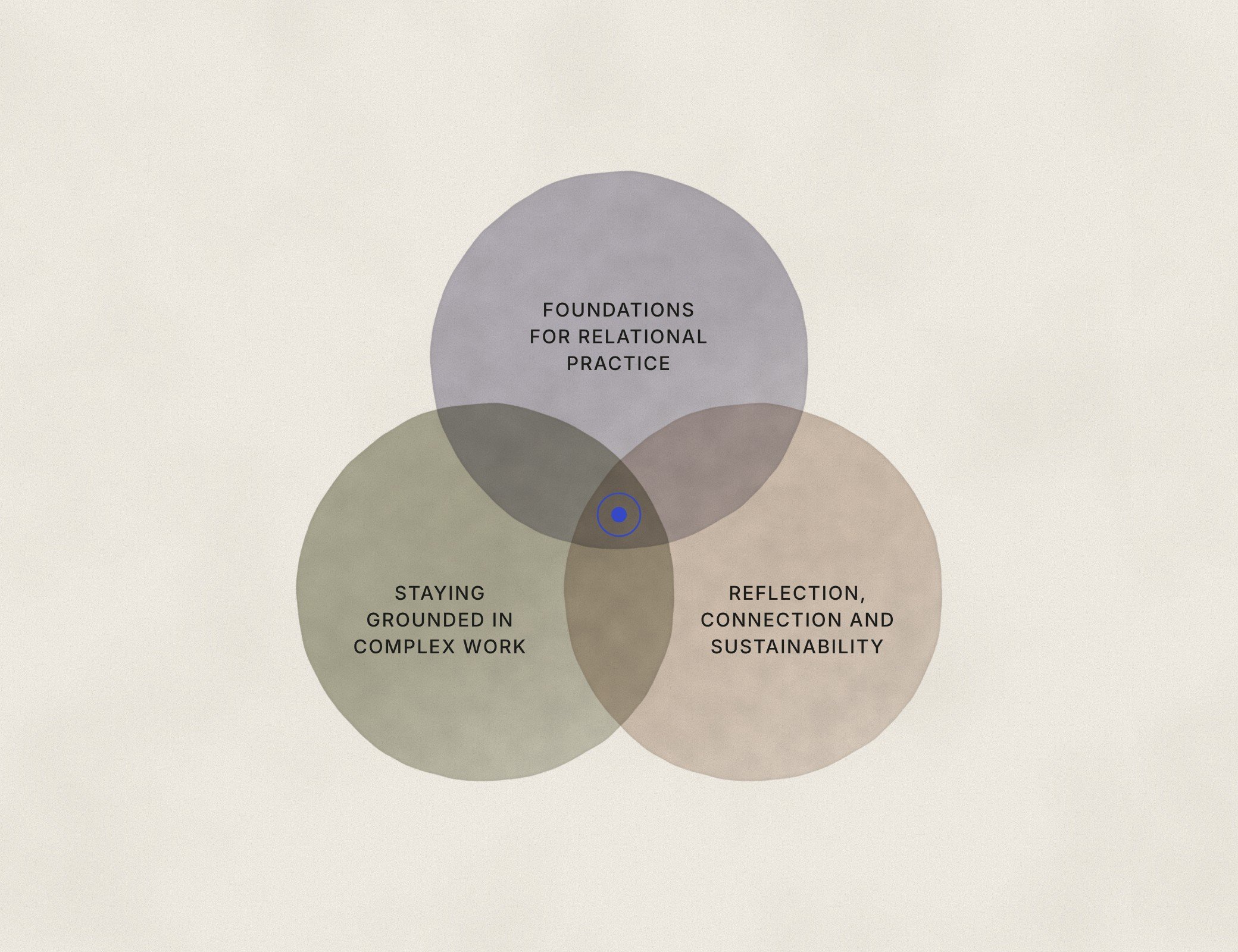
The toolkit is organised into three connected areas.
Organisations can select individual workshops or combine them to meet their learning priorities.
Designed for frontline workers who engage directly with clients, patients, students and groups, this workshop introduces the theory and science behind trauma-informed practice. Explore how trauma can affect safety, trust, relationships and engagement, and develop practical skills for building safety in everyday interactions.
Relational and care-based work can involve repeated exposure to other people’s distressing experiences. Explore how hearing about, witnessing or working closely with trauma can lead to secondary traumatic stress and vicarious trauma. Develop practical strategies for recognising and responding to these experiences, alongside an understanding of the personal, relational and organisational conditions that support recovery.
Explore the ongoing emotional work of empathy and care when supporting people experiencing distress, harm and complex life circumstances. Develop an understanding of emotional labour and empathic strain, including how our own experiences and responses can shape the way we engage with others. Consider practical, evidence-informed approaches to sustaining empathy, compassion and capacity in relational work.
Develop an accessible understanding of how the nervous system responds to stress, uncertainty and demanding experiences. Explore signs of activation, overwhelm and depletion, and how our bodies respond to ongoing demands. Through practical, body-based exercises, build greater awareness of your own stress responses and learn techniques to support regulation, recovery and co-regulation.
Develop practical ways to integrate reflection into everyday working life. Explore reflective practice techniques, interoceptive (body-based) check-ins and processing practices to build self-awareness, recognise personal responses and patterns, and carry learning from challenging experiences into practice. Learn to approach your experiences with curiosity and self-compassion.
Explore how connection, shared experience and collective approaches to care contribute to sustainable relational work. Consider the role of relationships, team cultures and organisational conditions in supporting resilience and wellbeing. Identify practical ways to strengthen connection, mutual support and shared responsibility for care at work.
FLEXIBLE DELIVERY
The Relational Worker Toolkit can be adapted to the needs, priorities and context of your organisation.
Three-hour sessions focused on a specific topic, suitable for professional development days, team learning or targeted capability development.
An extended learning experience combining related topics, with time for practical exercises, reflection and integration.
A sequence of workshops shaped around your workforce, existing learning priorities and the demands of your service or sector.
We work with organisations to identify appropriate content and delivery options, with attention to how learning can be applied in everyday practice.
See all programs → Reflective Practice Circles →Small groups, experiential exercises and time to absorb new learning.
Practise skills and body-based techniques in the session, not only talk about them.
Work with real situations from participants’ roles and leave with tools to use the next day.
Structured reflection connects new skills to the realities and conditions of each workplace.
Every session is trauma-informed, with choice about how people take part. The curriculum complements existing professional development and organisational wellbeing initiatives.
Jo Buick, drawing on 17 years across mental health, education and social justice.
Meet the team →What to expect
PEDAgogicaL APPRoach
Skills development is one part of a safe and sustainable workplace.
A BEST PRACTICE APPROACH
Under work health and safety laws, employers are required to identify and manage psychosocial hazards, starting with how work is designed and organised. Training on its own does not meet that duty, but it is an important part of a broader approach that also addresses workload, job design, leadership and support.
The Relational Worker Toolkit is designed to sit within that approach:
Teams learn to recognise empathic strain, stress responses and early signs of burnout, so concerns can be raised and addressed sooner.
Recovery skills, reflective practice and peer connection support wellbeing in roles with sustained emotional demands.
As appropriate, workshops include time for leadership and management reflections on workload, leadership and resourcing, so learning can inform organisational action as well as individual practice.
Sources: Safe Work Australia (2022), Model Code of Practice: Managing psychosocial hazards at work; Occupational Health and Safety Amendment (Psychological Health) Regulations 2025 (Vic).
Bring The Toolkit to your organisation
Whether you are looking for a standalone workshop, full-day training or a more structured learning program, we can work with you to identify an approach suited to your people and context.